TopSonics UI/UX Design
MedTech and industrial IoT interfaces. Product design, no implementation.
Summary
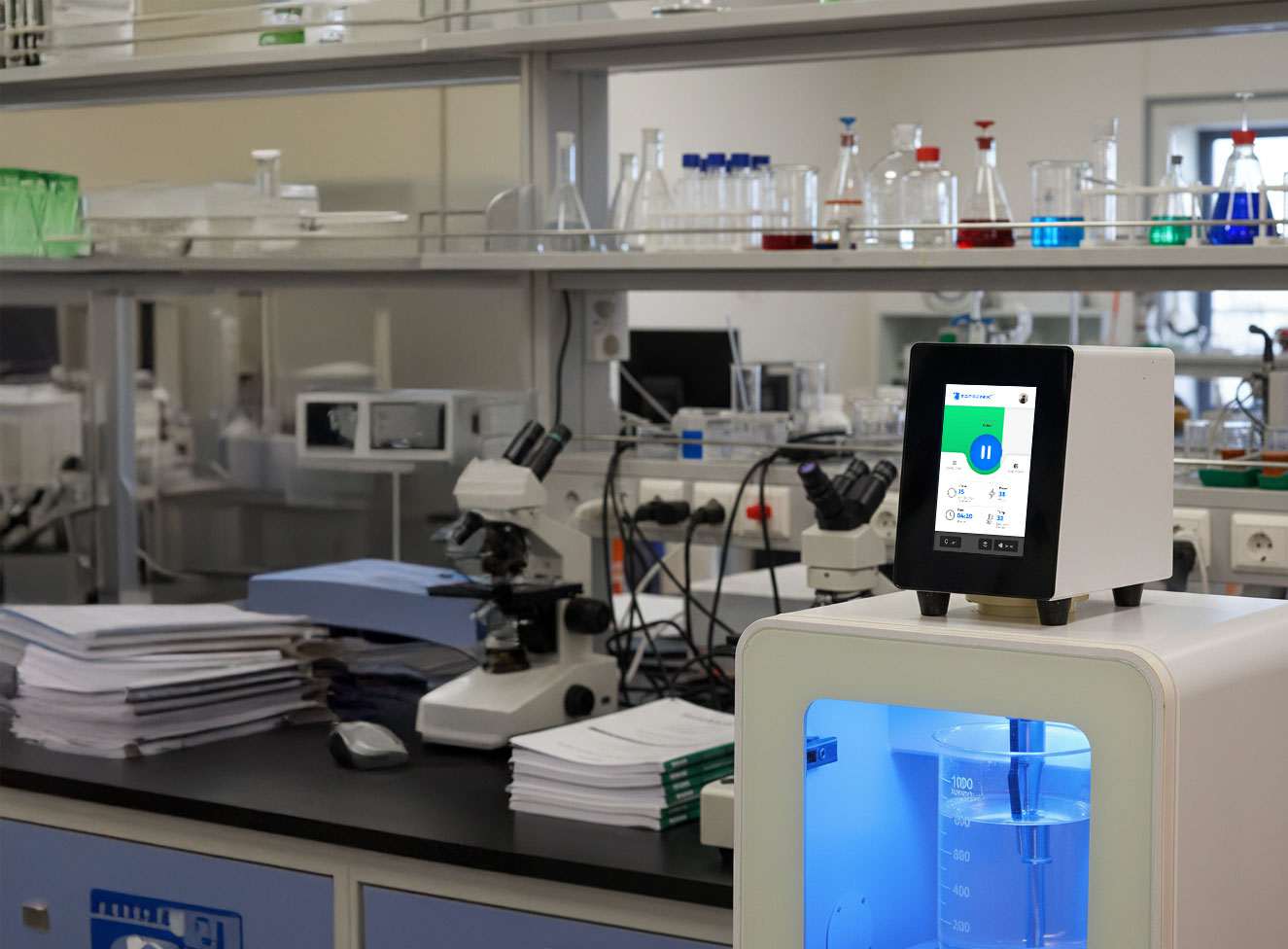
TopSonics builds ultrasonic homogenizers for laboratories. This interface runs on the instrument itself, so it is operated with gloves on, at a distance, mid-procedure. I designed it; TopSonics built it into the hardware.
The Challenge
Lab interfaces are used in gloves, under time pressure, around sensitive material, and a run started on the wrong frequency cannot be undone. Hardware also ships once, with no patch after release.
The goal: an instrument whose critical values read from across the bench and whose controls work through a glove.
My role: product design. I designed the interface; TopSonics built it into the hardware.
The constraint
This interface lives on a physical ultrasonic homogenizer, on a lab bench. Almost everything I rely on when designing for a screen is unavailable here: the operator is wearing gloves, may be standing a metre away, is often mid-procedure with a sample that has a clock on it, and cannot undo a run that started with the wrong frequency.
A hardware interface also ships once. There is no patch after release, which changes how much certainty you need before committing to a layout.
What I decided
Three values own the screen.Frequency, power and timer are what an operator checks from across the bench, so they are sized to be read at distance and never displaced by anything secondary. Every other parameter sits a level down.
Gloves set the touch targets.Control sizes and spacing were drawn for a gloved fingertip rather than a bare one, and every action gives feedback the operator can register without looking twice. In a lab, an unconfirmed press gets pressed again.
One layout across the product line.TopSonics sells a range of instruments. I designed the interface as a system that adapts per device rather than a screen for one model, so an operator who learns one instrument can use the next.
What I designed
Live intensity feedback:
ultrasonic output shown as it happens, so the operator sees the instrument doing what was asked.
Protocol setup:
homogenization sequences built in as few steps as the procedure allows, since setup happens with a sample already waiting.
A visual language for the range:
whites, greys and a single brand blue, holding across instruments without reading as consumer equipment.